
SoCal Golf Hall of Fame Welcomes Class of 2026
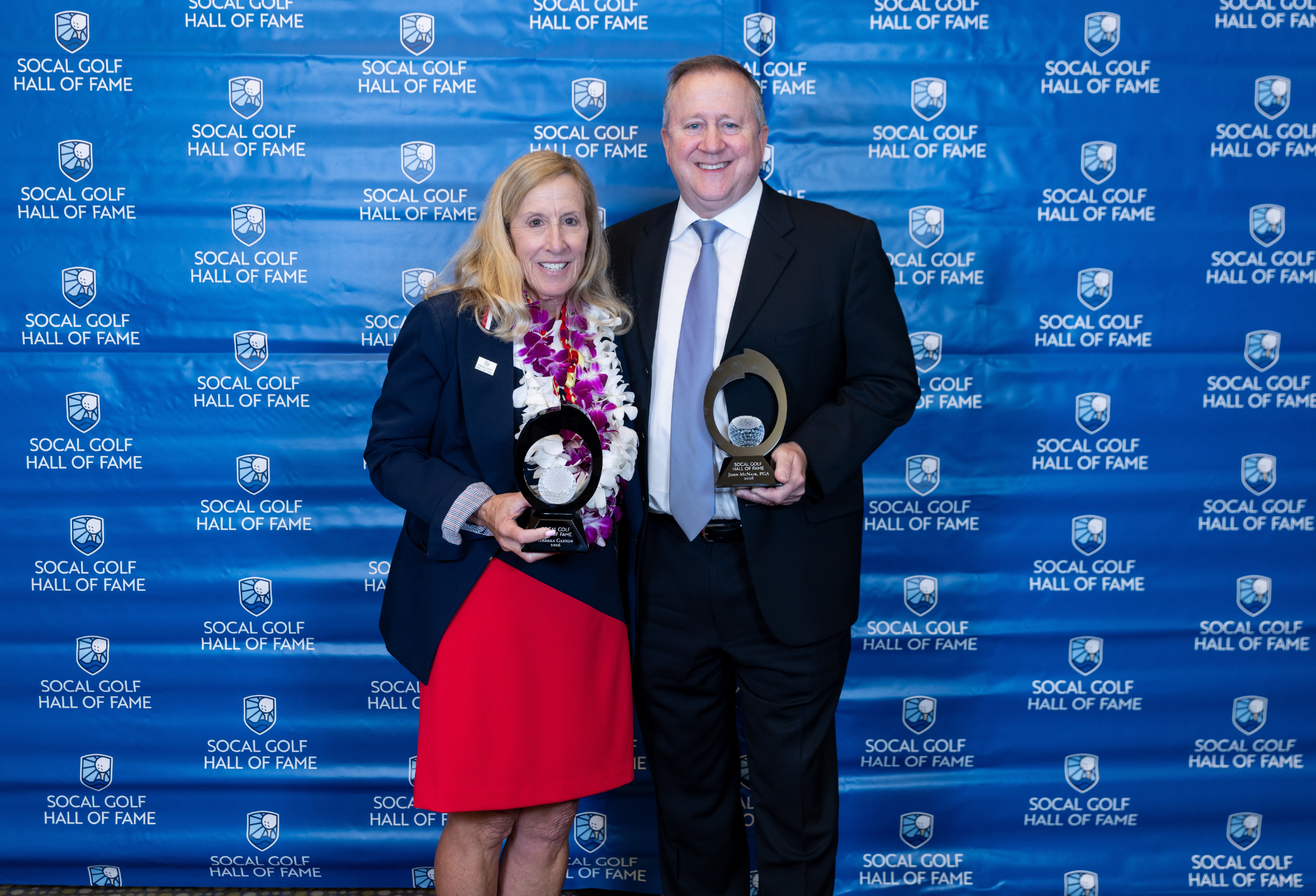
The Southern California Golf Hall of Fame welcomed its Class of 2026 at a luncheon ceremony held at Industry Hills GC. Headlined by three-time national champion, Andrea Gaston and historic civil rights pioneers, Bill Spiller and Maggie Hathaway, this class of inductees showcases a collection of trailblazers, legendary coaches, prominent executives and preeminent architects who’ve made a significant impact on the game of golf and helped shape its landscape in Southern California.
The SoCal Golf Hall of Fame welcomed the following individuals:
Andrea Gaston
Andrea Gaston, of Northridge, California, has long embodied what it means to pursue excellence. A standout amateur golfer turned legendary coach, her impact on the sport spans decades and continues to shape the next generation of champions.
Gaston first rose to prominence as one of the nation’s top amateur players, competing for San Jose State University, before stepping away from competitive golf in 1978. At the time, the Los Angeles Times cited “debilitating putting woes” as the reason for her departure. But her story was far from over.
In 1992, after a 14-year hiatus, Gaston returned to the game, launching one of the most impressive comebacks in amateur golf. Just one year later, she captured the 1993 California Women’s Amateur Championship, proving she had not only rediscovered her game but elevated it.
Her momentum only grew. In 1994, Gaston achieved a rare feat by qualifying for both the U.S. Women’s Open and the U.S. Women’s Amateur Championship in the same month at Old Ranch Country Club—earning medalist honors in both events. In the year leading up to those performances, she competed in two USGA Women’s Amateur Public Links Championships, she reached the semifinals of the U.S. Women’s Mid-Amateur Championship, claimed both the Los Angeles & Long Beach City Women’s Championships, finished runner-up at the Colorado Broadmoor Invitational, and climbed to No. 12 in Golfweek’s national amateur rankings.
She also successfully defended her California Women’s Amateur title, becoming the tournament’s first back-to-back champion in nearly twenty years.
“To be sitting here and having these reflections, I want those that are closet to me to know how thankful I am,” said Gaston through tears. “I’ve been fortunate to have people who have always believed in me and I’m so blessed to have them in my life.”
Before turning 40, Gaston transitioned from elite competitor to one of the most accomplished coaches in collegiate golf history. In 1996, she took over as head coach of the University of Southern California women’s golf program, beginning a remarkable 22-year tenure defined by sustained excellence.
Under her leadership, USC captured three national championships (2003, 2008, and 2013) and qualified for the NCAA Championship Tournament 21 consecutive times (the longest active streak in the country). More notable, her teams finished in the top-5 from 2006 to 2018. Gaston coached five NCAA individual champions, developed four NCAA Players of the Year, and earned WGCA National & Pac-12 Coach of the Year honors on three occasions. Her players accumulated 51 All-American selections, further cementing her legacy as a program builder and mentor.
In recognition of her extraordinary contributions, Gaston was inducted into the Women’s Golf Coaches Association Hall of Fame in 2010.
She left the collegiate ranks in 2023 as one of the most decorated coaches the sport has ever seen—an enduring symbol of perseverance, passion, integrity, leadership, and excellence.
John McNair, PGA
John McNair, PGA, was born into golf and has spent every day of his life around the game. His childhood home was a house on Fox Bend GC, just outside of Chicago, where his father was the longtime general manager and head professional, his mother kept the books, and his uncle served as superintendent. Before he was a teenager, McNair began working at the club in the cart barn and restaurant. As a junior golfer, he finished runner-up in two state championships.
McNair attended the University of South Florida where he experienced his first year-round golf season. He played on the men’s golf team where they achieved a national ranking inside the top-25 during his junior year. When McNair finished college golf, he became a full-time touring professional on the mini tour circuits.
In 1995, McNair took the head professional job at the brand-new Black Bear GC, just north of Orlando. It was here where McNair started to gravitate towards the business side of golf after meeting the owner of the course, who was only 33 years old and had just retired from a successful stint as a Wall Street financial professional.
McNair would soon take a job to serve as general manager at Cherokee Run GC near Atlanta. The club was managed by ValleyCrest and McNair was on-hand to participate in growing a portfolio of properties through golf course construction and acquisition. As his résumé and experience grew, so did his demand and, in 1999, JC Resorts recruited him to San Diego to run their golf division where McNair began a 26-year career that continues today.
“I was blessed to grow up in the business,” recalled McNair. “What I didn’t realize is that my early jobs were laying the foundation for everything to come. Most importantly, they laid the foundation of my love for the game of golf.”
While he has ascended as a golf executive and expanded JC Resorts as their Chief Operating Officer, McNair has always maintained his PGA membership. In 2015, after serving as secretary and vice president, he was elected as President of the Southern California PGA. During his time on the board, McNair played critical roles in initiatives driven to make golf more accessible for area youth including Neighborhood Golf and Golf in Schools.
McNair was subsequently elected to represent the regional district on the national level with the PGA Board of Directors in 2020. While on the board, he authored the PGA Endowment Fund and Reserve Policy. This policy ensured the continued growth of the PGA investment account and safeguarded the long-term sustainability of PGA programs for future generations of PGA Golf Professionals. He announced Phil Mickelson’s arrival to the 72nd green at the Ocean Course at Kiawah Island in 2021 where Mickelson would become, moments later, the oldest winner of a major golf championship.
Passionate about getting golf clubs in the hands of junior golfers, McNair serves on the board of the Wadsworth Golf Charities Foundation which funds projects like Links Across America, an initiative designed to build short courses to introduce young golfers to the game at “feeder facilities.”
Bill Spiller
Bill Spiller, a longtime Los Angeles resident and mainstay at Western Avenue CC (now Chester Washington GC), was also a champion golfer who remains an unsung hero of the desegregation of professional golf.
Born in 1913, Spiller grew up in Oklahoma and lived in Tulsa during the Race Massacre of 1921. Several years later, he’d move to Los Angeles where he worked as a porter at Union Station and lived with his mother.
When Spiller was 29 years old, a co-worker invited him to play golf for the first time and it’s said his scorecard reflected a round completed at 114 strokes. However, just a few short years later, Spiller would thrive at the game of golf and even win enough money from side games with boxing legend, Joe Louis, to buy a $7,000 house.
Bankrolled by Louis and not allowed to play in PGA tournaments, Spiller traveled the country playing with other Black golfers on the United Golfers Association where he won more than 100 tournaments. During this time, Spiller would openly and often lament the fact that the real money was offered on a tour he wasn’t allowed play.
When the L.A. Open was played at The Riviera CC in 1948, its progressive tournament committee ignored a longstanding clause in the PGA constitution that required competitors to be “Caucasian-only.” Spiller played in the event and shot an opening round 68 that landed him in second place, trailing only Ben Hogan. While Spiller would finish the event 20 strokes behind Hogan (the tournament’s eventual winner), it was reported that 12,000 fans followed and cheered for Spiller.
Spiller’s finish at the L.A. Open qualified him for a PGA event in Richmond, Calif., but when he arrived, the organizers invoked the “Caucasian-only” clause and barred him from competition. Spiller, alongside his friend and fellow golfer, Ted Rhodes, responded by suing for $250,000. Spiller’s lawsuit had frozen the funds for the PGA and the winner of the tournament in Richmond was issued a blank check.
The PGA told Spiller they would desegregate if he dropped his lawsuit. Spiller dropped his suit but the PGA kept the clause and changed the names of its tournaments from “Open” to “Invitational” and did not invite any non-Caucasian players.
In 1952, the PGA removed Spiller and four Black players who all qualified for the debut of the San Diego Open. Spiller stood on the first tee, in protest, and prevented the tournament from starting until he was eventually talked down by his fellow players. The protest garnered media attention that resulted in the PGA agreeing to let Black golfers compete only if they were invited by sponsors.
Spiller would play in 10 PGA events that year under sponsor exemptions but vowed to continue fighting for the permanent retirement of the Caucasian-only clause. Nearly a decade passed and the clause remained. In that time, Spiller, who started golf late, fell out of his prime, battled failing eyesight and became a caddie at Hillcrest CC.
At nearly 50 years old, Spiller told a member he was working for that his career was suppressed by the PGA’s segregation clause. The member he told had a close friendship with California Atty. Gen., Stanley Mosk, who then contacted the PGA and threatened to take away its access to California golf courses if they didn’t permit Black golfers to play. As a result, in 1961, 13 years after Spiller’s first lawsuit, professional golf became the last major sport in the U.S. to desegregate.
Spiller’s victory is regarded to be as tragic as it is triumphant. He paved the way for Charlie Sifford to become the first Black player with a PGA card, but never received a membership himself while he alive (the PGA of America granted posthumous membership to Spiller in 2009, over two decades after his death). Conversely, Spiller was known for his anger and contempt that built as a result having his best playing days vanquished by a clause he spent his entire career fighting. This anger and contempt led Spiller’s Southern California Golf Hall of Fame classmate, Maggie Hathaway, to write in the Los Angeles Sentinel after his death, “Bill Spiller died with a broken heart. He should have been the hero. But they made him the scapegoat.”
To this day, Spiller remains objectively lesser known and appreciated than other breakers of color barriers. Said Sifford of Spiller, “He was a great golfer, one of the best ever, Black or white.”
A native son of the Sooner State, Spiller was inducted into the Oklahoma Golf Hall of Fame in 2015.
Of Spiller’s legacy, the Los Angeles Times wrote in 1997, “The man most responsible for the appearance of Blacks on the PGA Tour was never even allowed to become a member of the PGA.”
Maggie Hathaway
Maggie Hathaway was a recording artist, an actor, a cabaret singer, a writer, a civil rights activist and, “perhaps the greatest advocate for L.A.’s Black golfers,” according to author and historian, Lane Demas.
Hathaway, who was born in rural Louisiana, set out for Southern California in the 1930’s with the goal of working as a musician on “Black Broadway” in Los Angeles. However, Hathaway would first pick up work as a Hollywood extra and was even hired as Lena Horne’s body double in the 1943 motion picture, Stormy Weather.
As written in the California Eagle newspaper, Hathaway ended her Hollywood career in protest when, as a film extra, she refused to wear a bandana and sit on a bale of cotton. She would later say, “My father was a farmer. He told us never to pick a piece of cotton. I handed [the director] the bandana and I quit Hollywood.” Hathaway would then return to singing in L.A. clubs and recorded several singles.
Hathaway became a major activist in Hollywood during the civil rights movement and it was her activism that prompted her to seek out boxing legend, Joe Louis, at Griffin Park GC to encourage him to stop participating in celebrity pro-ams while the PGA’s “Caucasian-only” clause barred non-famous Black golfers from playing.
During this meeting, Louis told Hathaway that he would buy her a set of golf clubs if she could hit the green from the tee box of the par-3 eighth hole. With her first ever swing of a club, Hathaway hit the green and Louis introduced her to the game of golf with a set of her own clubs.
This meeting and wager would set off a chain events that are still unfurling today. As Hathaway continued to play more golf and improve her game, she became increasingly agitated by the number of public courses in L.A. that were unavailable to Black players. What ensued was a series of advocacy efforts and activism for equality through protests, petitioning, writing golf columns in the California Eagle and Los Angeles Sentinel, and founding the Minority Associated Golfers (MAG) which championed more employment for Black people in the golf industry.
Using her influence and experience, Hathaway would launch the Beverly Hills-Hollywood chapter of the National Association for the Advancement of Colored People (NAACP) alongside her friend, Sammy Davis, Jr. She would also co-create the NAACP Image Awards which is now nearly 60 years old and continues to celebrate and award Black excellence in film, television, theatre, music, and literature.
When Lee Elder broke the color barrier at the 1971 Masters, Hathaway was there and even fainted after he was announced on the first tee. She was reported by the L.A. Times to have woken up in a medical facility next to Gary Player. A year later, in March of 1972, Hathaway teamed up with L.A. County Supervisor, Kenneth Hahn, to dedicate a practice putting green to juniors at Chester Washington GC. The ceremony was attended by the Jackson 5.
In 1997, more than a quarter-century after covering her first Masters tournament, she returned, credentialed by the Los Angeles Sentinel, and witnessed Tiger Woods become the first person of color to win the event. That same year, the Jack Thompson GC in South L.A. was renamed in her honor to the Maggie Hathaway GC.
In the year of her induction into the Southern California Golf Hall of Fame, a $21 million renovation of her namesake’s golf course is nearly complete. The project involves world-renowned architect, Gil Hanse, and a two-time major champion as its honorary chairman in Collin Morikawa. It will serve thousands of golfers every year, introduce juniors to the game, and remain a beacon of Hathaway’s light to make golf more equitable for everyone.
William Watson
William Watson was a businessman, project manager and one of the most prolific golf course architects in Southern California, and beyond, during the early 1900’s.
Born just 10 miles from the Old Course at St Andrews, Watson would join his father, a member of the R&A, for frequent golf rounds and developed an interest in course architecture. Watson would meet (and impress) an affluent golf tourist from Minnesota who wanted him to travel to Minneapolis and design the first nine holes of what would become The Minikahda Club. In 1898, just shy of 40-years-old, Watson boarded a transatlantic ocean liner for the United States and built what is still today the oldest golf club west of the Mississippi.
Watson didn’t stop his westward travels in Minnesota. One year after finishing his maiden build, he went to Los Angeles and quickly became the preeminent golf architect of the region. Watson’s first design came at the Redlands CC in 1900. That year, he would also build the first-ever nine-hole public golf course in Los Angeles called Garvanza Links. While the course has long since been demolished, a portion of it lives on today as a green grass integration into a Pasadena-area park of the same name.
Watson would open a retail store aimed to sell golf accessories and, in 1901, his father and brother traveled to L.A. to help him operate the business and assist with golf course construction.
In 1906, Watson was hired to build Annandale GC in Pasadena. While on property, he met the caddie master, William. P. Bell, Sr., and mentored the prodigy-to-be, ultimately appointing him to supervise many of his projects. As a result of the experience Bell gained from Watson, fellow renowned architect, George C. Thomas, hired Bell to be his right-hand-man on numerous occasions.
Watson would only live and work in Los Angeles during the winter. In the other seasons, he served as head professional back in Minnesota at The Minikahda Club and traveled the country designing and building other golf courses. Watson’s lifetime portfolio eclipsed 100 golf courses that he either designed or redesigned.
When Watson was 70 years old, the stock market crashed in 1929 and served as a precursor to the Great Depression. Watson’s career was immediately curtailed and his final design, the El Sobrante GC in San Pablo, Calif., was never completed.
Renowned architect, Tod Eckenrode, who redesigned many of Watson’s golf courses said, “Watson utilized the bold, often severe features of existing terrain beautifully in his routings. He wasn’t afraid to play along a sweeping hillside or up and over a ridge. He never practiced a cookie-cutter approach to design.”
The following list of Watson’s projects is from Fried Egg Golf and does reflect his entire portfolio. Some projects are designs and others are redesigns:
The Minikahda Club (1898), Town and Country Club (1900), Annandale GC (1906), Flossmoor Country Club (1910), Interlachen CC (1911), White Bear Yacht Club (1915), Brentwood CC (1918), Diablo CC (1920), Hillcrest CC (1920), Golden Valley Country Club (1920), Hacienda GC (with Billy Bell, 1920-24), San Diego CC (1921), Virginia CC (1921), Lakeside GC (with Max Behr, 1924), Orinda CC (1924), Belvedere Golf Club (1927), and La Jolla CC (1927).
With Sam Whiting as construction superintendent, Watson laid out two courses at The Olympic Club (1924-27) and TPC Harding Park (1925) and Sonoma GC (1928).
D. Scott Chisholm
Born in the small town of Kingussie, Scotland, D. Scott Chisholm would come to the United States in 1899 and make his name decades later as a golf writer during the Roaring ‘20s some 5,000 miles from his birthplace. He was an early and avid promoter of the game of golf, specifically in Southern California.
From his home in Ojai, Calif., Chisholm penned columns for the Los Angeles Evening Express newspaper and is even credited in some golf circles as a co-founder of the then-Los Angeles Open (now Genesis Invitational). Chisholm had written that Los Angeles should stage a tournament as part of something he had dreamed up called “Golf Week.” He imagined, through his column, that the festival would put the game of golf on a grand stage and show off Southern California’s winter weather to the rest of the world. L.A.’s Junior Chamber of Commerce, without crediting Chisholm, executed a very similar idea to the one he had written about and the first Los Angeles Open was held at The Los Angeles CC in 1926. Chisholm started the tradition of announcing golfers arriving to the 18th green at every Los Angeles Open, a signature moment of the event that carried on at the tournament after his passing and which was depicted in Ben Hogan’s biopic film, Follow the Sun. Fittingly, the championship, now known as The Genesis Invitational, celebrated its 100th edition just weeks before Chisholm’s induction into the Southern California Golf Hall of Fame.
Though hailing from Scotland, Chisholm had an unabashed, public love for the golf that Southern California offered. In 1929, citing Lakeside CC, Annandale CC, Wilshire CC and many others, he wrote in the American Golfer that “California was the standard of golf course architecture.” He would also say in the same article that public courses like Griffith Park GC and Western Avenue GC were just as beautiful and desirable to him as their neighboring private clubs.
Chisholm also wrote for Pacific Golf & Motor and The Fairway. He was a noted photographer whose portfolio was vital to documenting the early game and which later became the basis for the Ralph W. Miller Golf Library’s photo collection.
Chisholm co-founded the National Association of Left-Handed Golfers (NALG) and served as its first president in 1936. The NALG was solely responsible, decades later, for raising the manufacturing quality standards of left-handed golf equipment. Ninety years on, the NALG is still a functioning and robust organization.
In his obituary that appeared in a 1958 issue of Golfdom, it was reported that many Southern California professional and amateur golfers threw a big party for Chisholm’s 80th birthday, which occurred a few months before his death. That same article referred to Chisholm as “one of the kindliest and most generous of men.”
Learn more about the SoCal Golf Hall of Fame program here.