
Maggie Hathaway
Recording artist, actor, cabaret singer, writer, civil rights activist and advocate for L.A.’s Black golfers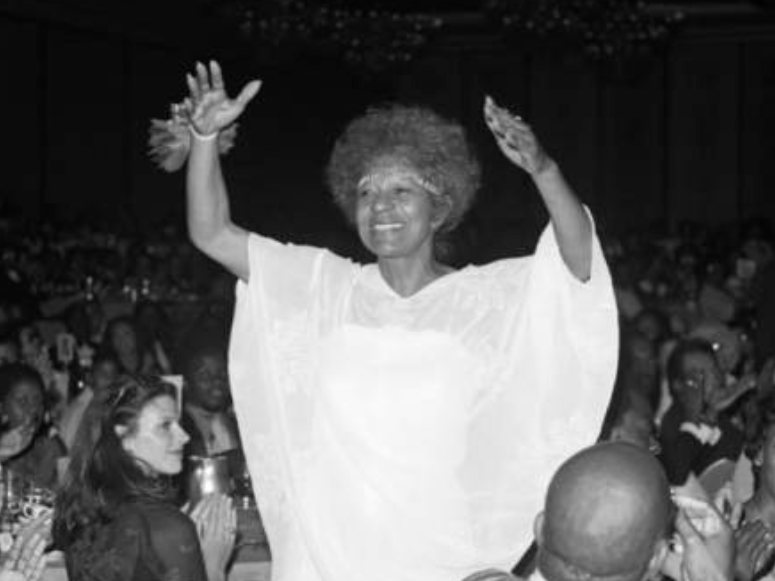
Maggie Hathaway was a recording artist, an actor, a cabaret singer, a writer, a civil rights activist and, “perhaps the greatest advocate for L.A.’s Black golfers,” according to author and historian, Lane Demas.
Hathaway, who was born in rural Louisiana, set out for Southern California in the 1930’s with the goal of working as a musician on “Black Broadway” in Los Angeles. However, Hathaway would first pick up work as a Hollywood extra and was even hired as Lena Horne’s body double in the 1943 motion picture, Stormy Weather.
As written in the California Eagle newspaper, Hathaway ended her Hollywood career in protest when, as a film extra, she refused to wear a bandana and sit on a bale of cotton. She would later say, “My father was a farmer. He told us never to pick a piece of cotton. I handed [the director] the bandana and I quit Hollywood.” Hathaway would then return to singing in L.A. clubs and recorded several singles.
Hathaway became a major activist in Hollywood during the civil rights movement and it was her activism that prompted her to seek out boxing legend, Joe Louis, at Griffin Park GC to encourage him to stop participating in celebrity pro-ams while the PGA’s “Caucasian-only” clause barred non-famous Black golfers from playing.
During this meeting, Louis told Hathaway that he would buy her a set of golf clubs if she could hit the green from the tee box of the par-3 eighth hole. With her first ever swing of a club, Hathaway hit the green and Louis introduced her to the game of golf with a set of her own clubs.
This meeting and wager would set off a chain events that are still unfurling today. As Hathaway continued to play more golf and improve her game, she became increasingly agitated by the number of public courses in L.A. that were unavailable to Black players. What ensued was a series of advocacy efforts and activism for equality through protests, petitioning, writing golf columns in the California Eagle and Los Angeles Sentinel, and founding the Minority Associated Golfers (MAG) which championed more employment for Black people in the golf industry.
Using her influence and experience, Hathaway would launch the Beverly Hills-Hollywood chapter of the National Association for the Advancement of Colored People (NAACP) alongside her friend, Sammy Davis, Jr. She would also co-create the NAACP Image Awards which is now nearly 60 years old and continues to celebrate and award Black excellence in film, television, theatre, music, and literature.
When Lee Elder broke the color barrier at the 1971 Masters, Hathaway was there and even fainted after he was announced on the first tee. She was reported by the L.A. Times to have woken up in a medical facility next to Gary Player. A year later, in March of 1972, Hathaway teamed up with L.A. County Supervisor, Kenneth Hahn, to dedicate a practice putting green to juniors at Chester Washington GC. The ceremony was attended by the Jackson 5.
In 1997, more than a quarter-century after covering her first Masters tournament, she returned, credentialed by the Los Angeles Sentinel, and witnessed Tiger Woods become the first person of color to win the event. That same year, the Jack Thompson GC in South L.A. was renamed in her honor to the Maggie Hathaway GC.
In the year of her induction into the Southern California Golf Hall of Fame, a $21 million renovation of her namesake’s golf course is nearly complete. The project involves world-renowned architect, Gil Hanse, and a two-time major champion as its honorary chairman in Collin Morikawa. It will serve thousands of golfers every year, introduce juniors to the game, and remain a beacon of Hathaway’s light to make golf more equitable for everyone.