
Bill Spiller, PGA
Professional golfer and trailblazer who helped break the sport's color barrier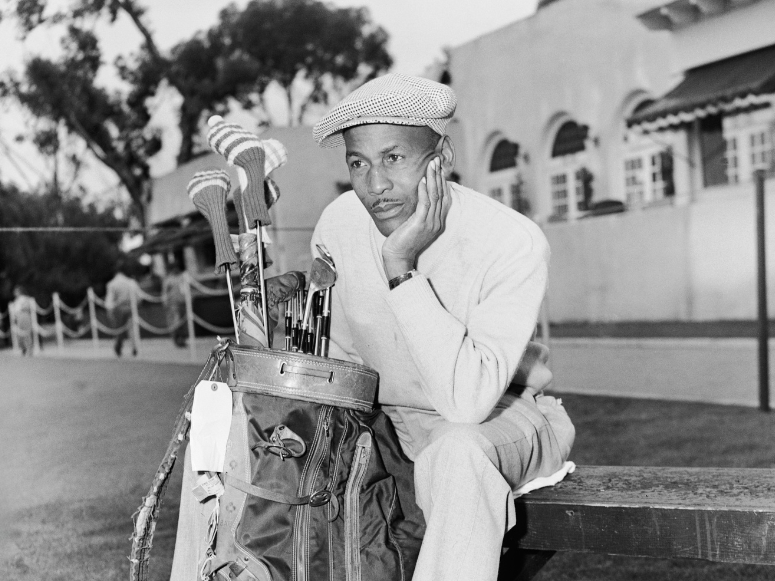
Bill Spiller, a longtime Los Angeles resident and mainstay at Western Avenue GC (now Chester Washington GC), was also a champion golfer who remains an unsung hero of the desegregation of professional golf.
Born in 1913, Spiller grew up in Oklahoma and lived in Tulsa during the Race Massacre of 1921. Several years later, he’d move to Los Angeles where he worked as a porter at Union Station and lived with his mother.
When Spiller was 29 years old, a co-worker invited him to play golf for the first time and it’s said his scorecard reflected a round completed at 114 strokes. However, just a few short years later, Spiller would thrive at the game of golf and even win enough money from side games with boxing legend, Joe Louis, to buy a $7,000 house.
Bankrolled by Louis and not allowed to play in PGA tournaments, Spiller traveled the country playing with other Black golfers on the United Golfers Association where he won more than 100 tournaments. During this time, Spiller would openly and often lament the fact that the real money was offered on a tour he wasn’t allowed play.
When the L.A. Open was played at The Riviera CC in 1948, its progressive tournament committee ignored a longstanding clause in the PGA constitution that required competitors to be “Caucasian-only.” Spiller played in the event and shot an opening round 68 that landed him in second place, trailing only Ben Hogan. While Spiller would finish the event 20 strokes behind Hogan (the tournament’s eventual winner), it was reported that 12,000 fans followed and cheered for Spiller.
Spiller’s finish at the L.A. Open qualified him for a PGA event in Richmond, Calif., but when he arrived, the organizers invoked the “Caucasian-only” clause and barred him from competition. Spiller, alongside his friend and fellow golfer, Ted Rhodes, responded by suing for $250,000. Spiller’s lawsuit had frozen the funds for the PGA and the winner of the tournament in Richmond was issued a blank check.
The PGA told Spiller they would desegregate if he dropped his lawsuit. Spiller dropped his suit but the PGA kept the clause and changed the names of its tournaments from “Open” to “Invitational” and did not invite any non-Caucasian players.
In 1952, the PGA removed Spiller and four Black players who all qualified for the debut of the San Diego Open. Spiller stood on the first tee, in protest, and prevented the tournament from starting until he was eventually talked down by his fellow players. The protest garnered media attention that resulted in the PGA agreeing to let Black golfers compete only if they were invited by sponsors.
Spiller would play in 10 PGA events that year under sponsor exemptions but vowed to continue fighting for the permanent retirement of the Caucasian-only clause. Nearly a decade passed and the clause remained. In that time, Spiller, who started golf late, fell out of his prime, battled failing eyesight and became a caddie at Hillcrest CC.
At nearly 50 years old, Spiller told a member he was working for that his career was suppressed by the PGA’s segregation clause. The member he told had a close friendship with California Atty. Gen., Stanley Mosk, who then contacted the PGA and threatened to take away its access to California golf courses if they didn’t permit Black golfers to play. As a result, in 1961, 13 years after Spiller’s first lawsuit, professional golf became the last major sport in the U.S. to desegregate.
Spiller’s victory is regarded to be as tragic as it is triumphant. He paved the way for Charlie Sifford to become the first Black player with a PGA card, but never received a membership himself while he alive (the PGA of America granted posthumous membership to Spiller in 2009, over two decades after his death). Conversely, Spiller was known for his anger and contempt that built as a result having his best playing days vanquished by a clause he spent his entire career fighting. This anger and contempt led Spiller’s Southern California Golf Hall of Fame classmate, Maggie Hathaway, to write in the Los Angeles Sentinel after his death, “Bill Spiller died with a broken heart. He should have been the hero. But they made him the scapegoat.”
To this day, Spiller remains objectively lesser known and appreciated than other breakers of color barriers. Said Sifford of Spiller, “He was a great golfer, one of the best ever, Black or white.”
A native son of the Sooner State, Spiller was inducted into the Oklahoma Golf Hall of Fame in 2015.
Of Spiller’s legacy, the Los Angeles Times wrote in 1997, “The man most responsible for the appearance of Blacks on the PGA Tour was never even allowed to become a member of the PGA.”